|
Home About Jeff Hamlett Birdroom Feeding Breeding Cinnamons and Whites Showing Photo Gallery Home bred birds 2003 Home bred birds 2004 Home bred birds 2005 Home bred birds 2006 Home bred birds 2007 For Sale Links
| |
Showing
Show Cage
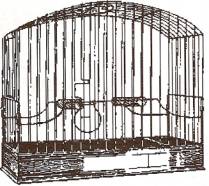
The show cage for the Fife canary is the Dewar show cage. This is the same
cage as used for the Border canary except that the perches are 1/2 inch diameter
instead of 5/8 inch for the Border and the gap between them is one wire less
i.e. position one perch at the drinker hole then count 6 wires and position the
second perch.

| Overall
length |
Overall
Width
|
Overall
Height
|
Base
|
Bottom
Rail
|
Corner
Posts |
Seed
Drawer |
Drawer
Handle
|
Drinking
Hole
|
Crossbar
|
Frame
|
Filling
|
| 12
5/8
|
4
Ύ
|
11"
and ends 9" |
3/32
thick
|
1
3/8"
wide x 3/16" thick
|
3
1/4"long x 3/16" sq.
|
1
½ long x Ύwide
|
½
x No. 6 round head screw
|
7/8"
long x Ύ wide
|
4
½ from
base inside
|
16
gauge wire
|
18
gauge wire |
Training
Show cage training for my young Fifes starts when they are about 5 weeks old.
This begins with a training cage (old show cage) being attached to the front of
the stock cage. The young birds soon treat the training cage as part of the
stock cage. After a few weeks I will occasionally remove the cage with one or
more young birds inside and just hold it to get the
birds confidence. I very rarely put birds in the training cages for any length
of time. My main training regime is to handle the birds in a training cage as
much as possible so that they are steady in the lead up to and during the
judging at a show.

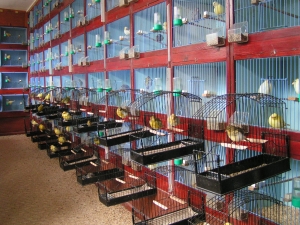
Some training cages attached to the stock cage
What you should be looking for in a show standard Fife
Canary
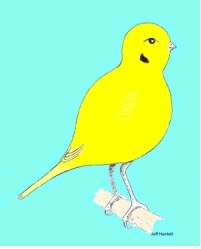
The image below is not the official Fife model but in my view would be
a very good guideline to base your stock on.
The points allocation are those used by the "Fife Fancy
Federation".
NB: Fife are sometimes called single season bird. This is because when the
bird has moulted into its adult plumage its
flights and tail feathers will grow back up to 1/4 inch or more longer, making the
adults (flighted) longer than the unflighted birds.
The Fife Standard Notes:
1. The grand essentials of a Fife Fancy are controlled roundness combined
with type, quality and natural colour, (that is non colour fed yellow, buff and
white ground only) in a diminutive form. When all other points are equal -
preference to be given to the bird nearest to the ideal length.
2. Points are the maximum that can be awarded for a feature. But not the
maximum it can be penalised for a serious fault - all features must be in
balance.
3. Shown in the standard Border Fancy show cage with non-drinker perch moved
in one wire - drinker hole may be reduced in size for extra small birds.
Standard of Excellence
| Feature |
Description |
Points |
|
HEAD: |
Small round and neat when viewed from any angle. Dark &
bright eyes near the centre. Beak fine. |
10 |
| BODY: |
Back well filled and nicely rounded but not heavy, the line
gradually tapering to the vent. |
10 |
| WINGS: |
Compact, carried close to the body, meeting at the tips
just below root of tail. |
10 |
| LEGS: |
Points - Medium length showing little thigh.
Feet proportionate. |
5 |
| PLUMAGE: |
Close firm and fine, presenting a smooth glossy silky
appearance and free from frill or roughness. |
10 |
| TAIL: |
Close packed and
narrow, nicely rounded and filled in at root. |
5 |
|
POSITION/
CARRIAGE: |
Semi erect standing at about 60-degree angle. Alert and jaunty moving confidently between perches. |
10 |
| COLOUR: |
Natural rich soft and pure, as level in tint as possible
throughout. |
10 |
| CONDITION: |
Clean and in perfect health. |
5 |
| SIZE: |
Ideal length 108mm (4Ό inches) or less. Tending towards a
diminutive bird. |
25 |
| |
|
|
| TOTAL |
|
100 |
Show Classification
This is a fairly standard classification. Some
clubs may add more or less depending on the entry. You will notice that in the
Fife World there are no 3pts dark classes, they are included with the heavily
variegated.
|
Champion
|
|
Novice
|
|
1
|
Clear or Ticked Yellow Cock.
|
35
|
|
2
|
Clear or Ticked Yellow Hen.
|
36
|
|
3
|
Clear or Ticked Buff Cock.
|
37
|
|
4
|
Clear or Ticked Buff Hen.
|
38
|
|
5
|
Green Variegated Yellow Cock.
|
39
|
|
6
|
Green Variegated Yellow Hen.
|
40
|
|
7
|
Green Variegated Buff Cock.
|
41
|
|
8
|
Green Variegated Buff Hen.
|
42
|
|
9
|
Green Heavily Variegated Yellow Cock.
|
43
|
|
10
|
Green Heavily Variegated Yellow Hen.
|
44
|
|
11
|
Green Heavily Variegated Buff Cock.
|
45
|
|
12
|
Green Heavily Variegated Buff Hen.
|
46
|
|
13
|
Green Self or Foul Yellow Cock
|
47
|
|
14
|
Green Self or Foul Yellow Hen.
|
48
|
|
15
|
Green Self or Foul Buff Cock.
|
49
|
|
16
|
Green Self or Foul Buff Hen.
|
50
|
|
17
|
Cinnamon Variegated Yellow Cock.(inc HV)
|
51
|
|
18
|
Cinnamon Variegated Yellow Hen. (inc HV)
|
52
|
|
19
|
Cinnamon Variegated Buff Cock (inc HV)
|
53
|
|
20
|
Cinnamon Variegated Buff Hen. (inc HV)
|
54
|
|
21
|
Cinnamon Self or Foul Yellow Cock.
|
55
|
|
22
|
Cinnamon Self or Foul Yellow Hen.
|
56
|
|
23
|
Cinnamon Self or Foul Buff Cock.
|
57
|
|
24
|
Cinnamon Self or Foul Buff Hen.
|
58
|
|
25
|
Clear or Ticked White Cock.
|
59
|
|
26
|
Clear or Ticked White Hen.
|
60
|
|
27
|
Variegated White Cock.
|
61
|
|
28
|
Variegated White Hen.
|
62
|
|
29
|
Heavily Variegated White Cock
|
63
|
|
30
|
Heavily Variegated White Hen
|
64
|
|
31
|
Blue or Fawn Self or Foul Cock.
|
65
|
|
32
|
Blue or Fawn Self or Foul Hen.
|
66
|
|
33
|
Any Flighted Cock
|
67
|
|
34
|
Any Flighted Hen.
|
68
|
Classification Definitions
Clear or Ticked

|
Clear bird is all yellow,
all buff or all white no markings at all.
A ticked bird would have a single
green, cinnamon, blue or fawn mark coverable by a new penny piece or 3 flights next to
each other forming a solid mark in either a wing or tail.
Current Fife Federation rules say that
a grizzle mark coverable by a penny will be shown in the variegated class.
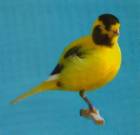
The bird shown here is a clear yellow.
|
Variegated

|
A variegated bird has a yellow, buff or white ground
colour with green, cinnamon, blue or fawn markings. These markings should
cover less than 50% of the feather area.
The bird shown here is a variegated green yellow.
|
Heavily
Variegated
 |
A heavily variegated bird should have between 50% and
75% of its feather area covered with colour.
I would consider this bird to be a border line case with
the markings just under 75%.
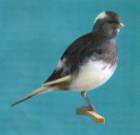
The bird shown here is a Heavily Variegated Blue.
|
3Pts
Dark

|
A 3 Parts Dark bird should, as its description
implies, have 75% or more of its feather area covered in colour.
I would consider this bird to be a border line case
with the markings just about 75%.
Note in the Fife world the 3Pts Dark is shown in the
Heavily Variegated classes.
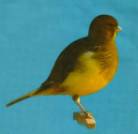
The bird shown is a 3Pts Dark Yellow Green.
|
Self or
Foul

|
A self bird should have no light markings so would be
all green or all cinnamon or all blue or all fawn. A Foul bird is the
opposite to a ticked bird i.e. a light mark coverable by a new penny piece
or 3 light flights in wing or tail forming a single mark.
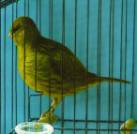
The bird shown is a Self Yellow Green.
|
|